Why Drywall Repair Is Different in West Palm Beach
West Palm Beach sits on the edge of the Atlantic coast with year-round humidity that rarely drops below 60 percent. From June through October, afternoon storms are a near-daily occurrence. This climate puts constant stress on interior drywall in ways that homeowners from other parts of the country do not expect when they move here.
Drywall is essentially compressed gypsum sandwiched between paper. Both components absorb moisture. In a dry climate, the small amounts of humidity that get into walls dry out quickly and cause minimal damage. In West Palm Beach, moisture has nowhere to go. It sits in the wall system, softens the gypsum, loosens joint tape, and over time shows up as bubbling paint, sagging tape seams, and soft spots that give under light pressure.
Beyond humidity, West Palm Beach homes also deal with settlement cracking from the sandy South Florida soil, damage from roof leaks that migrate down interior walls, and in older homes, the cumulative effects of decades of thermal expansion from extreme heat cycling. Understanding which type of damage you are dealing with determines how it should be repaired.
Common Types of Drywall Damage in West Palm Beach Homes
Hairline cracks at corners and seams. These are the most common and least serious. They typically appear where two pieces of drywall meet, or at the corners of door and window frames. In most cases they are the result of normal settling and seasonal movement. They can be filled with joint compound, re-taped if needed, and feathered smooth. They do not indicate a structural problem.
Nail pops. As a home settles, the wood studs behind the drywall shift slightly. This can push nails or screws outward, creating small circular bumps on the wall surface. Common in West Palm Beach homes built in the 1970s through 1990s. The fix involves driving the fastener back in, adding a second fastener nearby to hold the drywall securely, and filling the dimples.
Water damage from roof leaks or plumbing. This is the most serious category. Water-damaged drywall shows up as brown staining, bubbling paint, soft or crumbling gypsum, and in advanced cases, visible mold. The critical rule here: the source of the water must be fixed before any drywall repair is done. Patching over active moisture intrusion is a temporary fix that will fail within months.
Impact holes and dings. Doorknob holes, accidental impacts, and damage from moving furniture are common in any home. These are straightforward repairs involving backing material for larger holes, joint compound, and texture matching.
Tape seam failure. In high-humidity environments like West Palm Beach, the paper tape that reinforces drywall seams can separate from the wall over time. This shows up as a visible ridge or bubble running along a seam line, often in bathrooms, kitchens, or on exterior walls. Re-taping requires cutting out the failed section, applying new tape and compound, and feathering the repair into the surrounding wall.
Repair vs. Replace: How to Decide
Not all drywall damage requires full panel replacement. Getting this decision right saves money and avoids unnecessary disruption to a finished space.
Repair is appropriate when: the drywall is structurally sound (firm, not soft or crumbling), there is no active mold growth, the damage is cosmetic or limited to the surface layer, and the moisture source has been resolved. Most cracks, nail pops, small holes, and failed seams fall into this category.
Replacement is necessary when: the gypsum core is soft, wet, or disintegrating, visible mold is present in or behind the panel, the damage is larger than about half the panel, or the drywall has been saturated multiple times and shows signs of persistent moisture retention. Trying to skim coat over compromised drywall produces a repair that looks fine initially and fails within a year.
A professional assessment is worth getting if you are unsure. The cost of an incorrect decision, either patching something that should be replaced or replacing something that only needed repair, is higher than the cost of having someone experienced look at it first. For broader context on drywall repair across Palm Beach County, see our drywall repair Palm Beach County guide.
The Professional Repair Process
Understanding what a proper repair involves helps you evaluate whether a contractor is cutting corners. Here is what professional drywall repair in a West Palm Beach home looks like from start to finish.
Assessment and source confirmation. Before any repair work begins, the source of the damage needs to be identified. For water-related damage, this means confirming the leak is resolved. For cracking, it means ruling out active foundation movement. Skipping this step is how contractors get called back six months later for the same problem.
Cut-out or prep. Damaged sections are cut back to clean, undamaged material. For panel replacements, cuts are made to the nearest stud so the new panel has something to fasten to. For smaller patches, backing boards are installed behind the opening to give the patch material support.
Taping and first coat. New panels or patches are taped at the seams using paper or mesh tape embedded in joint compound. The first coat fills the tape and builds the base layer. In West Palm Beach humidity, this coat needs adequate drying time before the next step. Rushing it causes cracking in the finished repair.
Second and third coats. Each subsequent coat is applied thinner and feathered wider than the previous one, gradually blending the repair into the surrounding wall. Skipping coats or insufficient feathering produces a visible hump in the finished surface that paint makes worse, not better.
Sanding. Once fully dry, the repaired area is sanded smooth. Dust management matters here, especially in occupied homes.
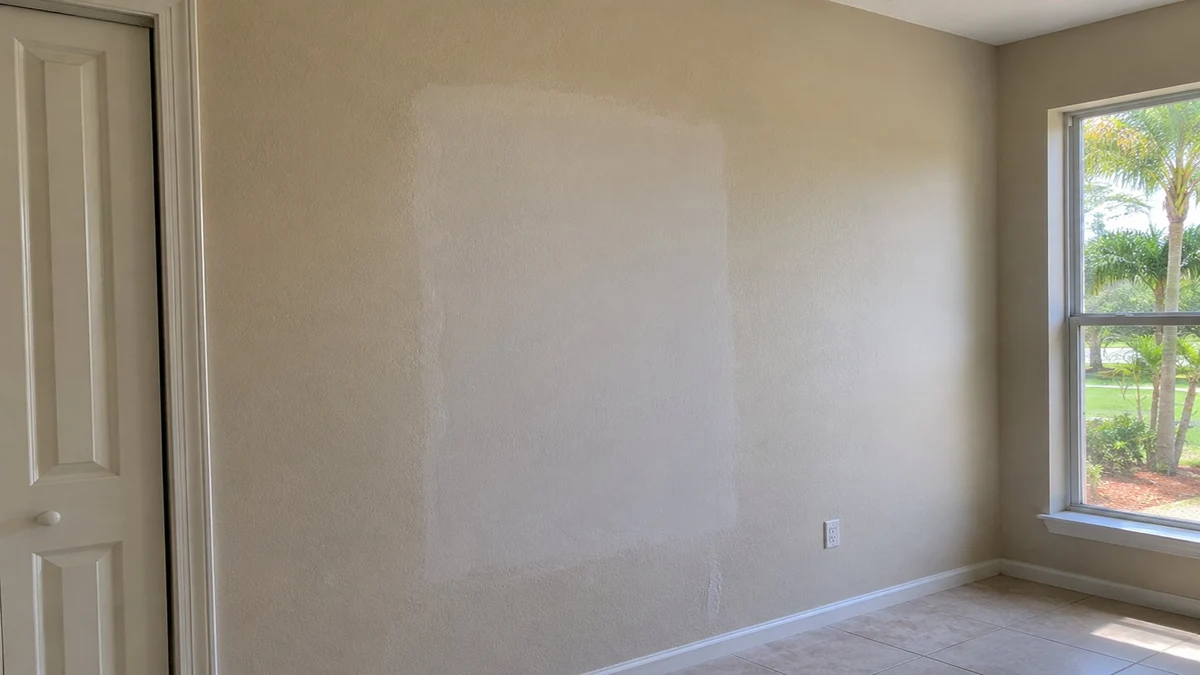
Texture matching. This is the step that most often separates a professional repair from a visible one. West Palm Beach homes typically have orange peel or knockdown texture. Replicating the existing texture on a patched area requires practice and the right equipment. A poorly matched texture will be visible in any light that hits the wall at an angle.
Priming. Repaired areas must be primed before painting. Fresh joint compound is highly absorbent and will cause the finish paint to look flat or inconsistent over the repair if applied directly without a primer coat. This is the step that most DIY repairs skip, and it is why those repairs are visible through the paint.
Drywall Repair Before Painting
If you are planning an interior paint project in West Palm Beach, drywall repair should happen first. Paint does not hide damage. Cracks, seam ridges, nail pops, and texture inconsistencies all become more visible under paint, not less. The sheen of the finish coat and the way light hits a painted wall will reveal every imperfection in the substrate beneath it.
The correct sequence for any interior painting project that involves drywall issues is: repair all damage, prime the repaired areas, then paint. Combining the trades into one project also saves money compared to scheduling them separately. For a full picture of what interior painting in West Palm Beach involves, see our interior painting West Palm Beach guide. And for details on our drywall repair service specifically, visit our drywall repair West Palm Beach service page.