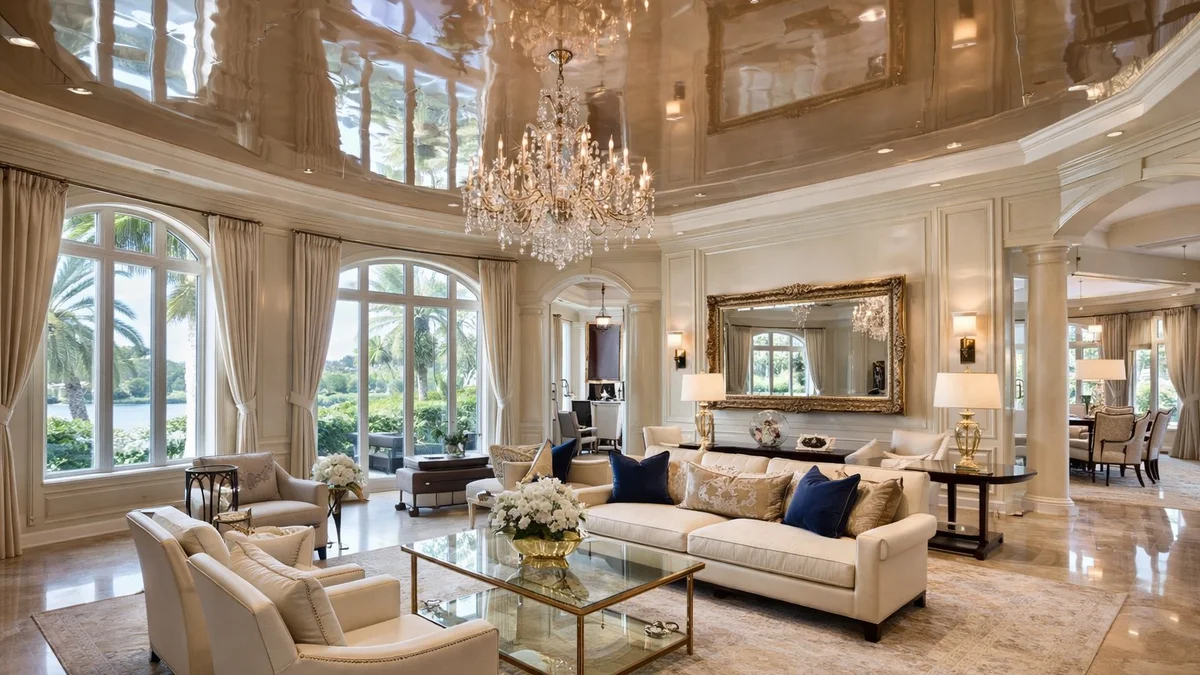
High gloss finishes have become increasingly popular in higher-end Boca Raton homes — particularly for ceilings, built-in cabinetry, trim work, and feature walls. The appeal is clear: when done correctly, a high gloss finish has a depth and luminosity that other sheens simply can't replicate. It reflects light in a way that makes spaces feel larger and more refined.
We do high gloss painting. We've done it in Boca Raton homes that look genuinely stunning as a result. We've also seen high gloss jobs done incorrectly — by other contractors and occasionally requested in situations where it wasn't the right choice — that ended up looking worse than what they replaced.
This is an honest look at what high gloss painting involves, when it works, and when we'd steer a homeowner in a different direction.
What Makes High Gloss Different
Paint sheen is determined by the ratio of pigment to binder in the formula and how the surface cures. Flat paint has almost no reflectivity — it absorbs light. Eggshell and satin have a low to medium sheen. Semi-gloss is noticeably reflective. High gloss is at the opposite end of the spectrum — it's the most reflective finish available in standard paint products, similar in appearance to a lacquered surface.
The high sheen level creates a mirror-like quality that can be dramatic and beautiful in the right context. It also makes the surface easy to clean — high gloss is the most washable of all paint finishes, which is part of why it's the standard for trim and doors in most homes.
What high gloss does not do is hide anything. Every imperfection in the surface beneath — every patch, every seam, every joint compound ridge, every brush mark, every roller stipple — shows under a high gloss finish. In fact, the reflective surface amplifies imperfections rather than hiding them, because light bouncing off the surface at an angle reveals every irregularity in sharp relief.
Where High Gloss Works Well
Trim, Doors, and Cabinetry
High gloss on trim, doors, window frames, baseboards, and built-in cabinetry is completely appropriate and looks excellent when the surfaces are properly prepared. These are smooth, stable surfaces that can be sanded to a fine finish before painting, and the high sheen on architectural woodwork is a classic look that suits Boca Raton's higher-end interiors well.
Feature Ceilings in the Right Conditions
High gloss ceilings have become a signature element in luxury interiors — a high gloss white or lacquered color ceiling in a room with good proportions and controlled lighting can be genuinely spectacular. The key word is controlled. In a room where the ceiling is perfectly smooth, the lighting is carefully placed, and the proportions support it, a high gloss ceiling is a statement piece that elevates the entire space.
In a room with a textured ceiling, visible imperfections, visible seams, or lighting that rakes across the surface at an unflattering angle, the same high gloss finish will make every flaw impossible to ignore.
Accent Walls and Specific Architectural Features
Used deliberately on a specific wall or architectural feature — a library wall, a foyer, a powder room — high gloss can work beautifully when the surface is properly prepared and the lighting supports it.
Where We'd Recommend Against It
The honest answer from 25 years of experience: high gloss is one of those finishes that most homeowners want when they see it in a magazine and regret when they see it on their own walls. Not always — but often enough that we treat it as a conversation, not just an order to execute.
Specifically, we'd have a direct conversation before applying high gloss to:
- Ceilings with any visible texture or imperfection. If the ceiling has been patched, has visible drywall seams, or has any texture, high gloss will make these features the focal point of the room. The prep required to get a ceiling to the standard that high gloss demands is extensive and sometimes not fully achievable.
- Large open wall areas in rooms with strong natural light. Direct sunlight on a high gloss wall creates intense glare and makes every imperfection visible throughout the day as the light angle changes.
- Rooms where the existing drywall is in variable condition. If the walls have been patched multiple times, have textured areas, or have surfaces that aren't uniformly smooth, high gloss will highlight these inconsistencies rather than unify the surface.
The prep requirement is non-negotiable: A high gloss finish applied over inadequate surface preparation will look worse than flat paint over the same surface. If a contractor agrees to apply high gloss without discussing the surface preparation requirements in detail, that's a sign they either don't understand what they're doing or they're not going to tell you what you need to hear.
What Proper Preparation Involves
Getting a surface ready for high gloss paint requires significantly more work than preparing for flat or satin finishes. For walls and ceilings, this typically means:
- Skim coating any areas that aren't perfectly smooth — filling low spots, feathering out patches, and creating a continuous flat plane
- Sanding the entire surface to remove any ridges, brush marks, or texture variations
- Applying a high-quality primer formulated for high-sheen topcoats
- Sanding again between coats as needed
- Using application techniques — typically spraying rather than rolling — that minimize stippling and brush marks in the finish coat
For trim and cabinetry, the process is similar: fill any nail holes or imperfections, sand to a fine finish, prime, and apply the finish coat with a method that produces a smooth result. Brush marks in a high gloss trim coat are immediately visible and require sanding and recoating to address.
Having the Conversation Before You Commit
When a homeowner in Boca Raton asks us about high gloss painting, our first step is always to walk the surfaces they're considering and give them an honest assessment of what the prep requirements are and what the realistic outcome will look like. Sometimes that conversation confirms that high gloss is exactly right for the situation. Sometimes it leads to a different sheen that achieves the desired effect without the risks.
We'd rather have that conversation upfront than have a homeowner unhappy with a result that could have been anticipated.
If you're still in the early stages of planning your project, our post on what to know before hiring a painting contractor in Boca Raton covers what to look for when evaluating contractors for specialty interior work. And if you're weighing color decisions alongside finish decisions, our guide on choosing exterior paint colors for a South Florida home has relevant thinking on how light and environment affect color choices here.
If you're considering high gloss painting for your Boca Raton home and want an honest assessment of whether it's the right choice for your specific surfaces and conditions, we're happy to come out and walk it with you. Visit our interior painting in Boca Raton page or call us at 561.501.1673.